Understanding internal book structure
Internal book structure is a hierarchical framework used by natural gas companies to organize their commercial, operational, and financial activities. It provides clarity on how contracts, deals, customers, and risk exposures are grouped and tracked.
The hierarchy follows this structure:
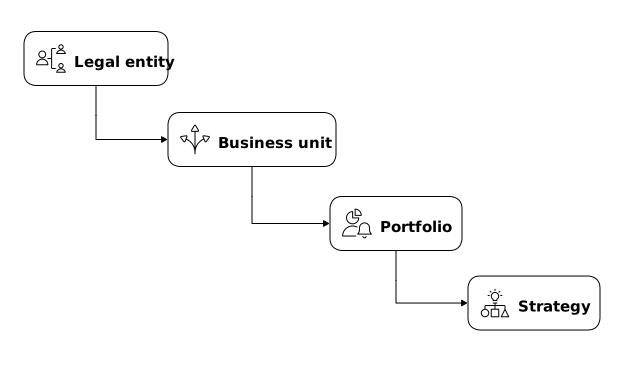
Legal entity
A legal entity is the officially registered company that participates in the natural gas market. It holds the licenses, regulatory approvals, and contractual rights needed to operate.
The primary responsibilities of legal entities are:
- Signs contracts with suppliers, pipelines, utilities (LDC), and customers.
- Ensures compliance with state and federal energy regulations.
- Maintains financial books for accounting and reporting purposes.
Example: ABC Gas Co. is a licensed supplier authorized to sell gas to retail customers in multiple states.
- Contracts:
- With pipelines for transportation.
- With utilities (LDC) for delivering gas to end-users.
- With end customers for retail supply.
Business unit
A business unit breaks down the company’s activities into distinct lines of business. This structure helps isolate financial performance, operational processes, and compliance requirements. It also enables reporting of profits/losses by line of business, helps align operations with regulatory compliance and provides focus on customer type and contract structures.
A typical business unit is split into:
| Business unit | Primary responsibilities |
|---|---|
| Retail | Supplies residential and commercial end-users. |
| Wholesale | Manages large-scale supply agreements with pipelines or industrial buyers. |
| Trading | Optimizes supply by buying/selling capacity or commodity at hubs and exchanges. |
Portfolio
A portfolio is a logical grouping of customers, contracts, or regions within a business unit. It ensures that exposure, margins, and operations can be tracked at a granular level. It helps:
- Organize customers based on Local Distribution Company (LDC), regions, or customer categories.
- Enable risk management and reporting per group.
- Simplify operational tasks like scheduling, billing, and balancing.
Example: NY Residential portfolio (all residential customers under ConEd)
- Business Unit: Retail
- Customers: All ConEd residential customers
- Purpose: Track consumption, margins, and risk exposure for ConEd service territory.
Strategy
A strategy defines how a portfolio is managed from a pricing, procurement, and risk perspective. It reflects the commercial approach and financial hedge mechanisms applied to customers and contracts.
The primary responsibilities are:
- Control margin performance by aligning pricing with procurement.
- Track exposure to fixed vs index prices.
- Monitor hedging activities and their impact on portfolio risk.
Example:
- Fixed price strategy: Customers locked at a set price (e.g., $5.50/MMBtu).
- Index strategy: Customers priced at NYMEX + basis.
- Hedging strategy: Futures/options/contracts purchased to reduce exposure to price volatility.
Profit and loss (P&L) visibility in nGenue
When billing or performing risk reporting, nGenue allows profit and loss (P&L) to be viewed at multiple levels of the internal book structure. This ensures transparency and helps stakeholders assess performance from high-level company results down to specific pricing strategies:
| Hierarchy level | P&L reporting perspective |
|---|---|
| Legal entity | Shows overall company performance across all activities and markets. |
| Business unit | Separates performance by line of business, such as Retail vs. Wholesale. |
| Portfolio | Enables P&L visibility by region, customer type, or utility (e.g., NY vs. NJ portfolios). |
| Strategy | Provides insights into how pricing and procurement approaches (e.g., Fixed vs. Index) are impacting margins and risk. |
This multi-level P&L reporting helps decision-makers understand profitability drivers, evaluate risks, and optimize strategies in real time.
Hierarchy walkthrough with real-world example
Let’s look at how the hierarchy works together in practice:
-
Legal entity:
ABC Gas Co. is a registered company operating in New York and New Jersey. -
Business unit:
- Retail: Supplies residential and commercial customers.
- Wholesale: Sells bulk gas to municipal buyers.
- Trading: Manages supply purchases and NYMEX futures.
-
Portfolio (retail business unit):
- NY residential portfolio: Includes all ConEd residential customers.
- NJ industrial portfolio: Includes factories under PSE&G.
-
Strategy (for NY residential portfolio):
- 50% of customers on Fixed Price Strategy at $5.50/MMBtu.
- 30% of customers on Index Strategy (NYMEX + basis).
- 20% of exposure hedged using futures contracts.
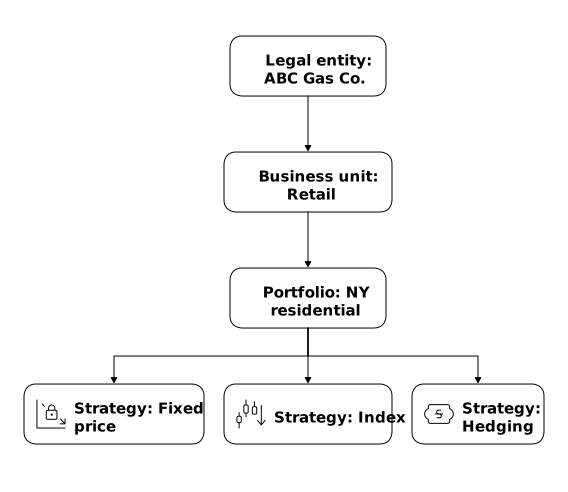
This hierarchical model ensures that natural gas businesses can manage contracts, customers, and risks in a real-time, structured, and transparent way.
When performing billing or risk reporting, nGenue provides visibility into Profit and Loss (P&L) at multiple levels of the Internal Book Structure. This hierarchical structure allows organizations to measure performance from the highest company-wide level down to specific strategies, ensuring accurate financial reporting and better decision-making.