Configuring swap deal blotter
The Swap Deal Blotter screen is used to create, manage, and book swap deals between counterparties within the Deal Management module. It allows users to view all pending swap deal entries, create new swap deals based on defined templates, and finalize them with appropriate trade statuses such as Active, or What-If.
The primary purpose of the Swap Deal Blotter configuration is to:
- Create and track swap deals within a specified date range.
- Associate each deal with a defined counterparty, strategy, and template.
- Automatically generate pending deal entries for further review.
- Facilitate booking of finalized swap deals with defined trade statuses.
- Maintain transparency in swap deal execution and post-trade audit.
Prerequisites
Before configuring swap deals in the Swap Deal Blotter screen, ensure the following prerequisites are met:
- The user have the add or modify permissions for the Swap Deal Blotter screen.
- The relevant counterparty is configured and active in the system.
- The swap templates (such as Production Swap or Financial Swap) are predefined in the Deal Management screen. This is done by selecting the This deal is a template checkbox while creating a swap deal from the Deal Management screen.
- The associated strategies are already defined under the Internal Book Structure screen.
- The start date and end date selected for swap deals fall within an open trade period.
- You have access to Legal Entity and Business Unit configurations.
Procedure to configure swap deals
Step 1: Navigate to the Swap Deal Blotter screen
- Log in to the nGenue application.
- Click the Search icon and enter Swap deal in the search bar.
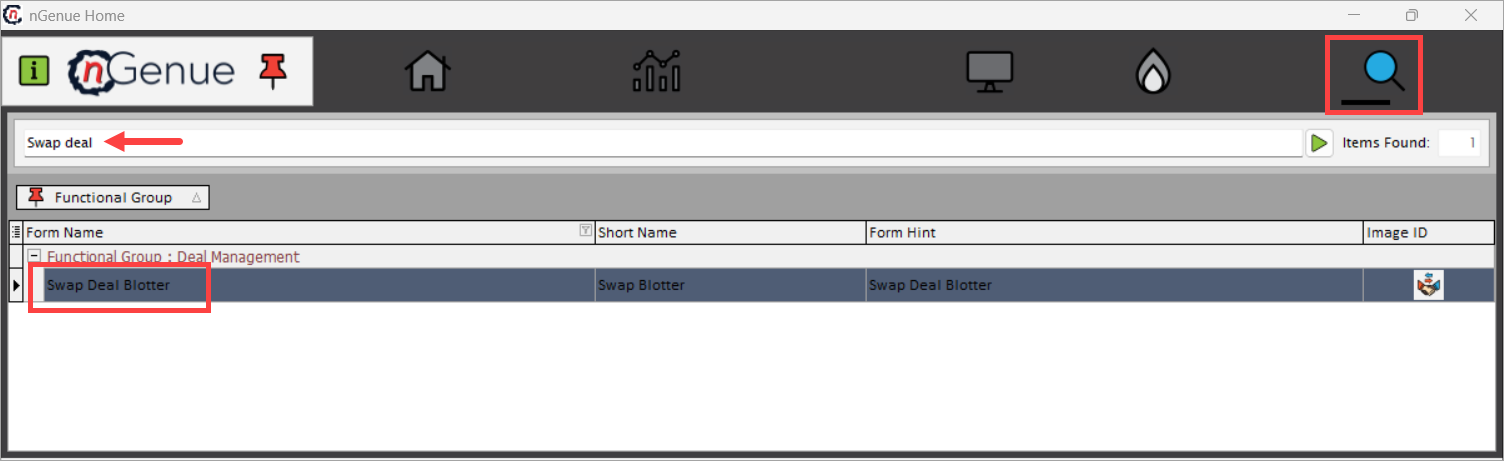
- Double-click Swap Deal Blotter to open the screen.
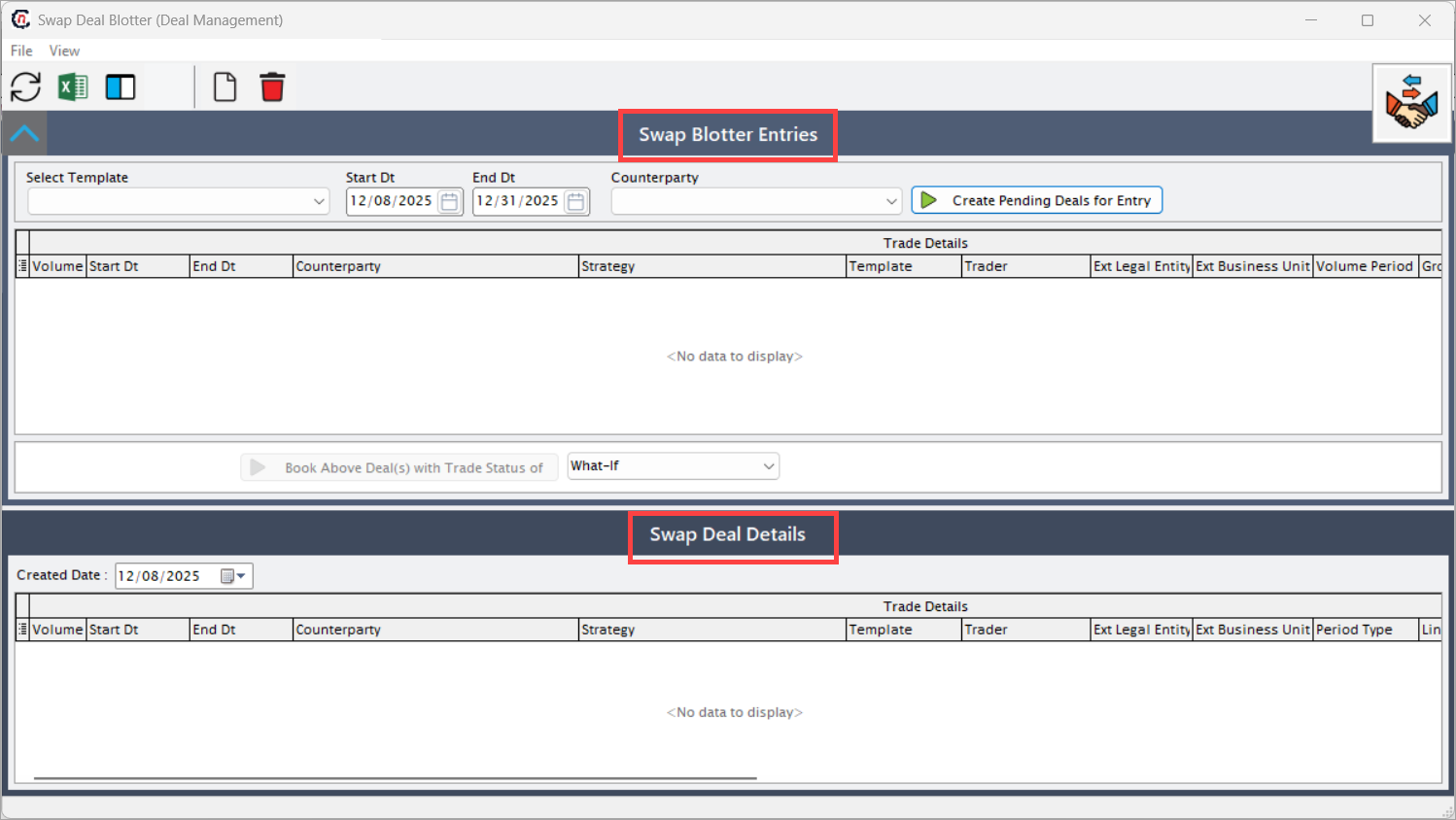
- The Swap Deal Blotter (Deal Management) screen consists of two main sections:
- Swap Blotter Entries: Used to create and view pending swap deal entries before booking.
- Swap Deal Details: Displays booked swap deals filtered by creation date.
Step 2: Select a deal template
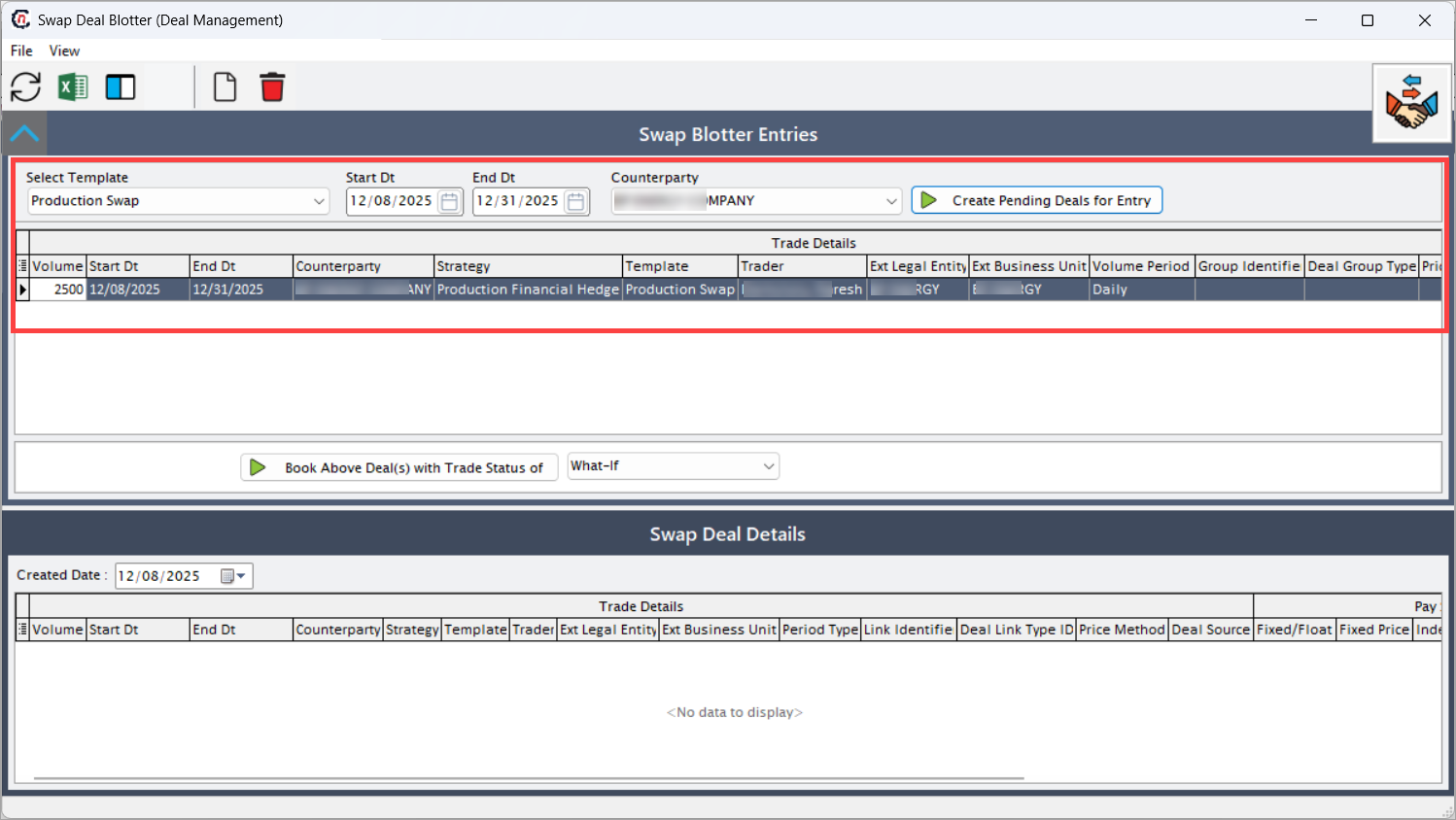
- From the Select Template dropdown in the Swap Blotter Entries section, choose a swap deal template that you have created in the Deal Management screen.
- Enter the Start Dt and End Dt to define the date range for which you want to view or create deals.
- Optionally, select a Counterparty from the dropdown list.
- Click the Create Pending Deals for Entry button to generate pending deal records for the selected criteria.
Step 3: Review pending swap entries
The system displays the list of swap blotter entries that match the filter criteria. Each record shows key trade details as described in the table below:
| Fields | Description |
|---|---|
| Volume | Displays the trade volume associated with the swap deal. |
| Start Dt | Indicates the start date of the swap deal validity. |
| End Dt | Indicates the end date of the swap deal validity. |
| Counterparty | Displays the counterparty organization involved in the swap. |
| Strategy | Displays the selected trading or hedging strategy. |
| Template | Indicates the template type used for deal creation. |
| Trader | Displays the trader name who is creating or booking the deal. |
| Ext Legal Entity | Indicates the external legal entity code linked to the counterparty. |
| Ext Business Unit | Displays the external business unit name. |
| Volume Period | Defines the frequency of trade volume. The available options are: • Daily – Volume applies to each day in the period. • Weekly – Volume applies to each week. • Monthly – Volume applies to each month. |
| Group ID | Displays the deal grouping identifier (if applicable). Used for linking related trades. |
Step 4: Book swap deals
- Review the list of generated pending deals.
- From the Book Above Deal(s) with Trade Status of dropdown, select the trade status you want to apply.
- Active – Marks the deal as live and executable. Active deals are included in exposure reports, valuations, and position summaries.
- What-If – Creates the deal as a simulation or hypothetical trade. What-If deals are used for forecasting and do not impact actual exposures until converted to Active.
- Click the Play (▶) button to book the selected swap deal(s).
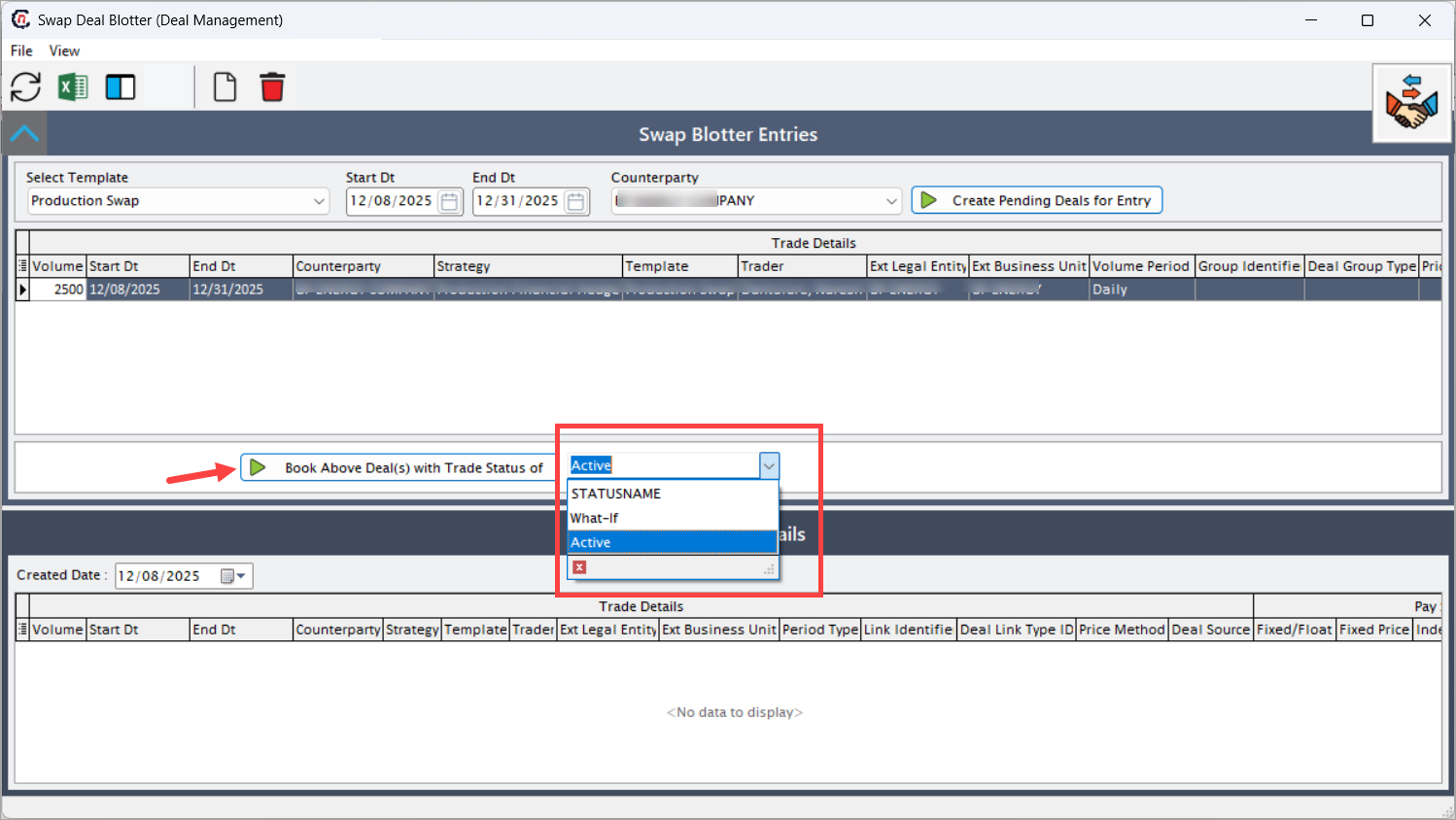
Once booked successfully, the deal status changes based on the selected option, and details are transferred to the Swap Deal Details section.
Step 5: Review swap deal details
The Swap Deal Details section at the bottom displays the booked deals filtered by the selected Created Date. Each record includes in-depth trade attributes as shown below:
| Fields | Description |
|---|---|
| Volume | The confirmed trade volume for the booked swap deal. |
| Start Dt / End Dt | The effective start and end dates for the booked swap deal. |
| Counterparty | The counterparty organization associated with the deal. |
| Strategy | The trading strategy under which the deal is booked. |
| Template | The selected swap template applied during booking. |
| Trader | The trader responsible for executing the deal. |
| Ext Legal Entity / Ext Business Unit | The external legal entity and business unit associated with the deal. |
| Period Type | Defines the trade period type. Options include: • Daily – Deal settles or rolls on a daily basis. • Weekly – Deal aggregates into weekly settlement periods. • Monthly – Deal rolls on a monthly settlement cycle. |
| Link Identifier | A unique system-generated identifier linking this deal to related trades or hedge instruments. |
| Deal Link Type ID | Identifies the type of linkage (e.g., Swap Pair, Mirror Deal). |
| Price Method | Specifies how the deal price is determined. Options include: • Fixed – A pre-agreed fixed price per unit is applied for the entire deal period. • Floating – The price is determined based on an external price index or benchmark (for example, daily or monthly price postings). |
| Deal Source | Indicates the source of deal creation. Options include: • Manual Entry – Entered manually by the trader. • Imported – Uploaded through an external interface or data file. • System Generated – Automatically created by the system as part of hedging or portfolio balancing logic. |
| Fixed/Float | Identifies whether the deal leg is fixed or floating. Options include: • Fixed – Price remains constant for the deal duration. • Float – Price varies based on an external index or floating rate. |
| Fixed Price | Displays the fixed price per unit, applicable for fixed leg deals. |
| Index | Displays the price index or benchmark associated with floating leg deals. Examples include published market indices or regional gas hubs. |
If no swap deals have been booked for the selected date, the system displays the message “No data to display”.
Key points to remember
- Always ensure that date ranges do not overlap across multiple deals for the same counterparty and strategy.
- Deals can only be booked if a valid template and strategy are selected.
- Volume Period consistency is mandatory to avoid reconciliation mismatches.
- Use comments or deal identifiers to maintain audit traceability.
- Booked deals automatically flow to the deal valuation and financial hedge reports.
- What-If deals can later be converted to Active status for inclusion in exposure and valuation reports.
Summary
The Swap Deal Blotter screen provides a centralized interface to manage all swap transactions. It enables traders to:
- Create and monitor pending swap entries.
- Book swap deals directly from predefined templates.
- Associate counterparties, traders, and strategies efficiently.
- Review and validate booked deals using detailed trade attributes.
After configuration, the details from the Swap Deal Blotter are also reflected in the Mark to Market screen to facilitate mark-to-market value calculations.